 Day Tours from Tokyo
Izu Peninsula from Tokyo: A Practical Train Guide
The Izu Peninsula from Tokyo is one of the few worthwhile day trip targets that no catalog tour covers, so you go by train. The Odoriko limited express puts you at the seaside in Atami in about 1 hour 20 minutes, and the line continues down the east coast to Ito and Shimoda. This page covers the trains, the fares, the places worth your time and the honest question of whether one day is enough. If you want a guided day instead, the day tours from Tokyo cover Hakone and Mt Fuji. The bookable tours are compared on day tours from Tokyo.
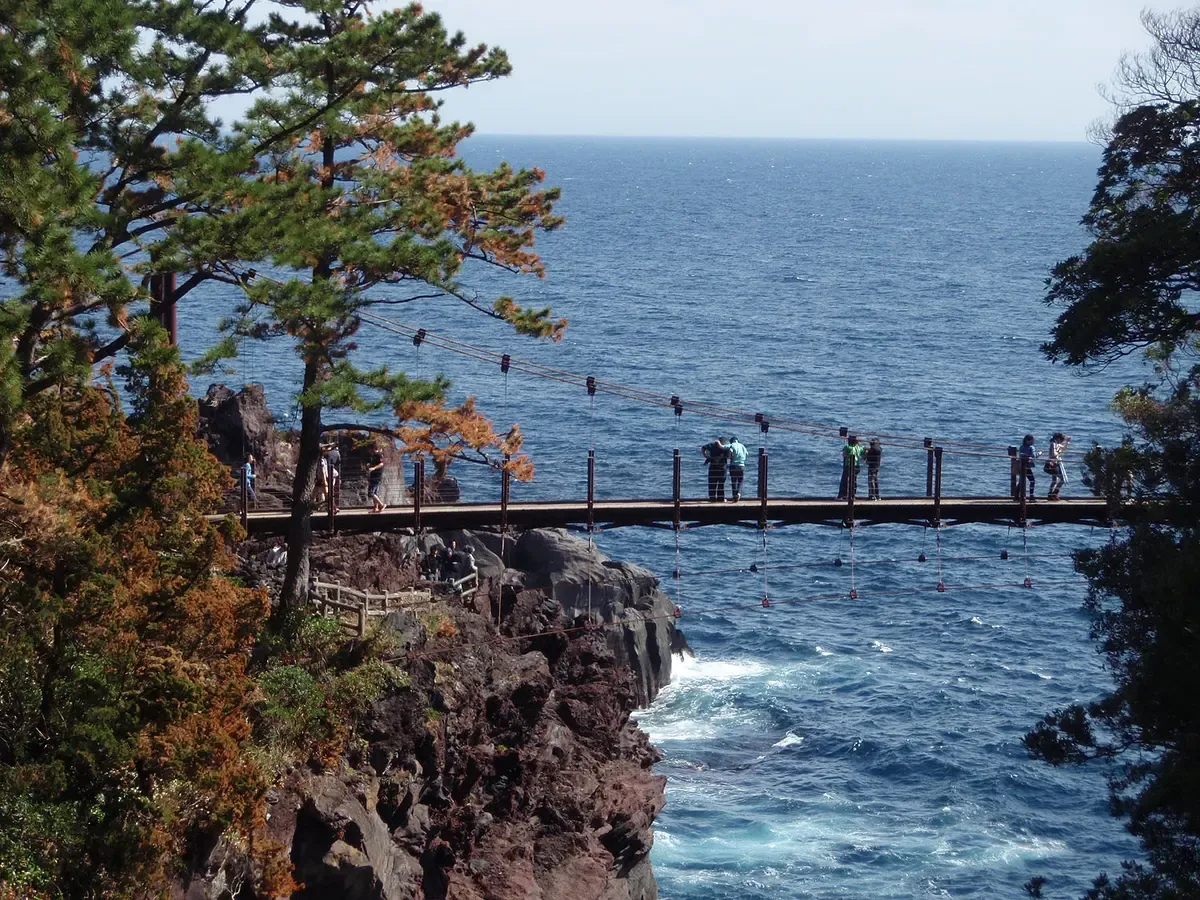
A suspension bridge crosses a gap in the rocky Jogasaki Coast. Photo: Batholith, Public domain, via Wikimedia Commons
Quick answer Izu by train in one minute
The Odoriko limited express runs from Tokyo to Atami in about 1 hour 20 minutes for around 3,500 yen, to Ito in about 100 minutes and to Izukyu-Shimoda in about 2 hours 49 minutes. Atami is a genuine day trip from Tokyo. The deeper peninsula, including Kawazu and Shuzenji, rewards an overnight. No bookable day tour from Tokyo goes to Izu, so this is a do-it-yourself trip by train.
Key takeaways
- Check the train table in Tokyo to Izu by Train before you choose a base.
- Atami, the Jogasaki Coast, Kawazu and Shuzenji each get their own section under Where to Go in Izu.
- Read A Day or a Night? before committing to Shimoda in one day.
- If you would rather ride a guided coach, a guided alternative is a Hakone cruise day trip at $83.48.
Tokyo to Izu by Train
Every route into the peninsula from Tokyo starts on the Tokaido corridor. Four services matter, and the fare gap between them is wide.
The Four Ways to Atami and Beyond
The Odoriko is the workhorse. It leaves Tokyo as a limited express, stops at Atami and runs down the Izukyu line through Izu-Kogen to Shimoda, so it is the only train in the table that takes you deep into Izu without a change. The Saphir Odoriko launched in March 2020 as an all-Green-Class train with a cafe car. The Shinkansen is the fastest way to Atami but stops there, so it only helps for an Atami day trip or a connection to Mishima for Shuzenji. The plain JR Tokaido local train is the cheapest at 1,980 yen and takes about 100 minutes to Atami.
All fares below are approximate, as published by Japan Guide and JPRail.
| Train | To | Time | Fare |
|---|---|---|---|
| Odoriko limited express | Atami | about 1 hour 20 minutes | around 3,500 yen |
| Odoriko limited express | Ito | about 100 minutes | around 4,000 yen |
| Odoriko limited express | Izukyu-Shimoda | about 2 hours 49 minutes | around 6,500 yen |
| Odoriko limited express | Shuzenji | about 2 hours | not stated |
| Saphir Odoriko (all Green Class, cafe car) | Atami | not stated | not stated |
| Tokaido Shinkansen | Atami | 40 to 50 minutes | around 4,000 yen |
| JR Tokaido local train | Atami | about 100 minutes | 1,980 yen |
Choosing Between Them
For an Atami day trip from Tokyo the Shinkansen takes 40 to 50 minutes for around 4,000 yen, against about 1 hour 20 minutes for around 3,500 yen on the Odoriko. The Odoriko makes more sense the moment you plan to go past Atami, because it continues into the peninsula. Note that IC cards such as Suica pay only the base fare on a limited express, and the supplement is bought separately.
For an onsen soak instead of Izu, see the onsen day trip from Tokyo guide.
Sources: Japan Guide and JPRail
Where to Go in Izu
Four bases cover most first visits to the Izu Peninsula from Tokyo: Atami on the north edge, the Jogasaki Coast near Ito, Kawazu on the east coast, and Shuzenji inland.
Atami
Atami is the closest corner of Izu and the only part that fits comfortably into a short day. Atami Castle costs 1,000 yen for adults and opens 9:00 to 17:00. The MOA Museum of Art charges 1,600 yen for adults, opens 9:30 to 16:30 and closes on Thursdays, so check the day before you build the trip around it.
Kinomiya Shrine is free and open 24 hours. Atami Sun Beach opens for swimming from the second Saturday of July to 31 August, 9:00 to 17:00. Atami is also a working onsen town, and if a bath is the main goal, the onsen day trip from Tokyo guide compares other options.
A Sample Day in Atami
Atami is the one part of Izu that fits a relaxed day from Tokyo, because the Shinkansen gets there in 40 to 50 minutes for around 4,000 yen, and the slower local JR Tokaido train takes about 100 minutes for 1,980 yen. The list below puts the paid and free stops in a workable order, using the opening hours each site publishes.
- Morning: Kinomiya Shrine, free and open 24 hours, before the day-trip crowds arrive
- Late morning: the MOA Museum of Art, 1,600 yen, open 9:30 to 16:30 and closed on Thursdays
- Afternoon: Atami Castle on the hill, 1,000 yen, open 9:00 to 17:00
- Late afternoon in July and August: Atami Sun Beach, open for swimming 9:00 to 17:00 from the second Saturday of July to 31 August
- Evening: an onsen bath, then the Shinkansen back to Tokyo
The Jogasaki Coast
The Jogasaki Coast is a lava cliff shoreline near Ito, formed by an eruption of Mount Omuro about 4,000 years ago. Its signature crossing is the Kadowaki Suspension Bridge, 48 m long and 23 m above the sea. To reach it, take the Izukyu line to Izu-Kogen, about 25 minutes from Ito, then a 10 minute Tokai bus and a 15 minute walk.
Coming from Tokyo, the Odoriko gets you to Ito in about 100 minutes for around 4,000 yen, so Jogasaki is achievable as a long day trip but eats a lot of the day in transit.
Kawazu and the Cherry Season
Kawazu is famous for Kawazuzakura, an early-blooming cherry variety that flowers over about a month from early February. The trees line about 4 km of the river, and the Kawazu Cherry Blossom Festival draws almost two million visitors a year. The 2026 edition ran 7 February to 8 March.
Night illuminations run 18:00 to 21:00 during the festival. Kawazu sits further down the line than Ito, and this page has no published Tokyo to Kawazu train time. Crowds of that size also mean the festival is a poor pick if you dislike queues.
Shuzenji
Shuzenji is the inland onsen town, and the practical route from Tokyo is the Shinkansen to Mishima, about 45 minutes, then the Izuhakone Railway to Shuzenji, 35 minutes for 550 yen. The Odoriko also runs through to Shuzenji directly from Tokyo in about 2 hours. The town's two fixed sights are small: a bamboo grove path only about 100 m long, and Tokko-no-yu, a historic bath source that is for viewing only, with no bathing.
The real reason to come is a ryokan stay with dinner and a bath, which makes Shuzenji an overnight destination rather than a day one.
Shimoda
Shimoda is the end of the Odoriko line, about 2 hours 49 minutes from Tokyo for around 6,500 yen one way. A same-day return from Tokyo means that ride twice. Shimoda sights, opening hours and fees are not covered here, so treat the town as a base for a longer stay down the peninsula.
Discovering the Izu Peninsula | 2-Day Trip from Tokyo
Atami, the Jogasaki coast and the rest of Izu over two days. Third-party video by Japan Guide. This site did not shoot it and has no relationship with the creator.
A Day or a Night?
The honest answer depends on how far down the peninsula you want to go.
What Fits in a Day
Atami fits easily. The ride is about 1 hour 20 minutes each way on the Odoriko, or 40 to 50 minutes by Shinkansen, leaving real time for the castle, the museum or the beach. The Jogasaki Coast is possible but tight: roughly 100 minutes to Ito, then a train, bus and walk before you see the suspension bridge, and the same again coming home.
Shimoda is about 2 hours 49 minutes each way by Odoriko, so a day trip there is mostly a train trip with a short stop in the middle.
Why an Overnight Wins Below Ito
Once you add Shuzenji, which sits inland on a separate branch, no single day covers it with the coast. A night in Izu turns two rushed days into one relaxed one: bath in the evening, cherry trees or coast in the morning. If your heart is set on a guided single-day format instead, the bookable day tours from Tokyo do not run to Izu at all.
A guided alternative is Hakone, for example the Mt Fuji cruise and Hakone Ropeway day trip for $83.48, which includes the ropeway, a Lake Ashi cruise and a guide, with lunch paid on the day.
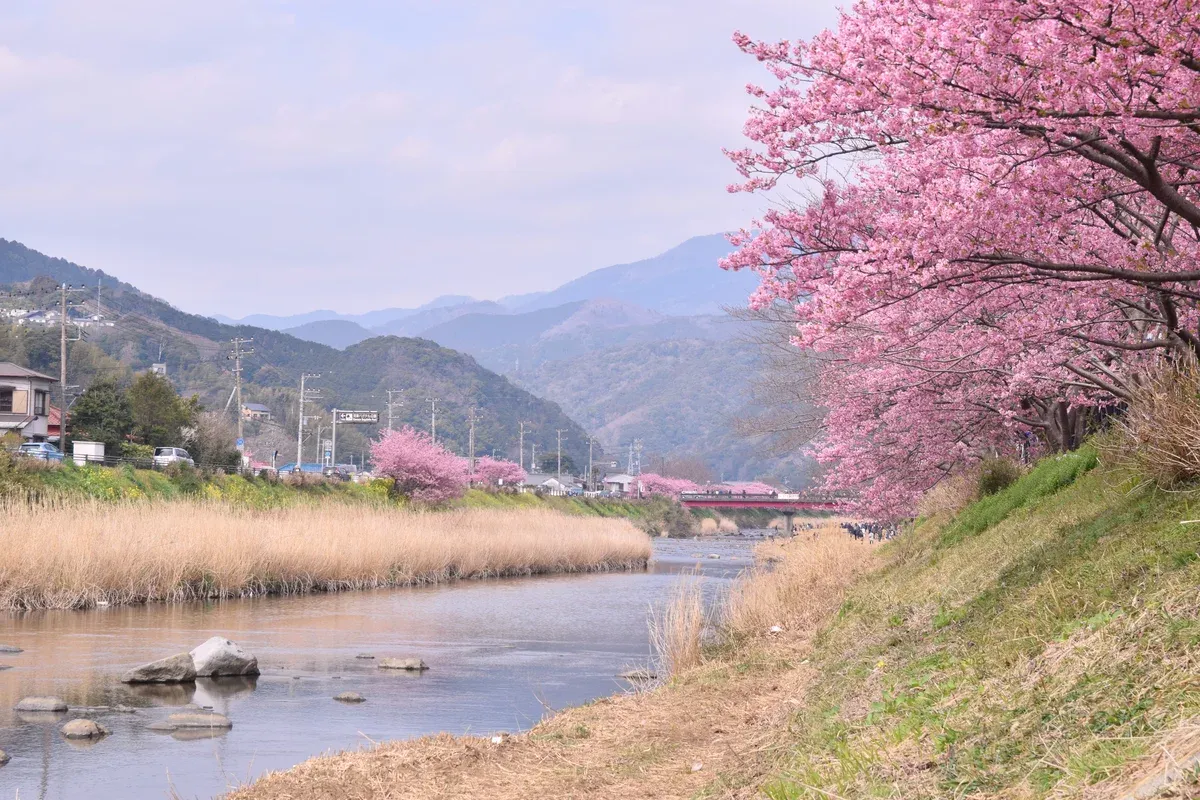
Early-blooming Kawazu cherry trees line a river in the Izu Peninsula. Photo: 雷太, CC BY 2.0, via Wikimedia Commons
If You Would Rather Be Guided
No tour in the catalog on this site goes to Izu. The nearest guided days run to Hakone, on the far side of the same mountains.
Two Hakone Days Instead
The Hakone cruise and ropeway bus tour costs $83.48 and includes the Hakone Ropeway and the Lake Ashi cruise, with a meeting point in Shinjuku at 8:00 AM. The Mt Fuji and Hakone day tour costs $76 and includes the ropeway one way, with the cruise paid on the day. Neither stops in Atami or on the Izu coast, so pick one only if a guided day near the mountains matters more to you than the sea.
For Izu itself, the Odoriko from Tokyo to Atami in about 1 hour 20 minutes for around 3,500 yen is still the simplest way in.
Frequently Asked Questions
Is Izu a day trip from Tokyo?
Parts of it are. Atami works as a day trip, about 1 hour 20 minutes from Tokyo by Odoriko. The Jogasaki Coast is a long day, and Shimoda at 2 hours 49 minutes each way is better as an overnight. See A Day or a Night?.
How do I get from Tokyo to the Izu Peninsula?
By train, on the Odoriko limited express to Atami, Ito or Shimoda, or the Shinkansen to Atami in 40 to 50 minutes for around 4,000 yen. The full comparison is in Tokyo to Izu by Train.
Is the Izu Peninsula worth visiting?
Yes, if you want coastline, early cherry blossoms or an onsen town, and you accept the travel time. If you want a short easy trip, closer options are compared in the guide to day trips from Tokyo.
How many days should I spend in the Izu Peninsula?
One day covers Atami, two days cover the coast around Ito and Jogasaki at a human pace, and a third adds Shuzenji inland. For a do-it-yourself frame, start from the free day trips from Tokyo hub.
Are there guided tours from Tokyo to Izu?
No catalog day tour from Tokyo covers Izu, so plan the trains yourself. If you want a guided coach day nearby, the Hakone format is the substitute, for example the Mt Fuji cruise and Hakone Ropeway day trip, and Hakone itself has its own day trip guide.