 Day Tours from Tokyo
Tokyo to Kyoto Bullet Train: Every Fare, Train and Station Explained
The tokyo to kyoto bullet train is the fastest way to cover the 515.4 km between the two cities, and this guide explains the whole journey on your own. You get the real fares for the Nozomi, Hikari and Kodama, the difference between reserved and non-reserved seats, where to buy tickets from machines or the Smart EX app, and the JR Pass rule that catches many travelers out. It also covers which seat to pick for a Mt Fuji view, the oversize baggage rules, and what to do the moment you step off at Kyoto Station. If you would rather skip the planning, day tours from Tokyo include a guided Kyoto day that rides the same line, and it appears at the end of this page. Everything here comes from official and published sources, and where sources disagree, both figures are shown.
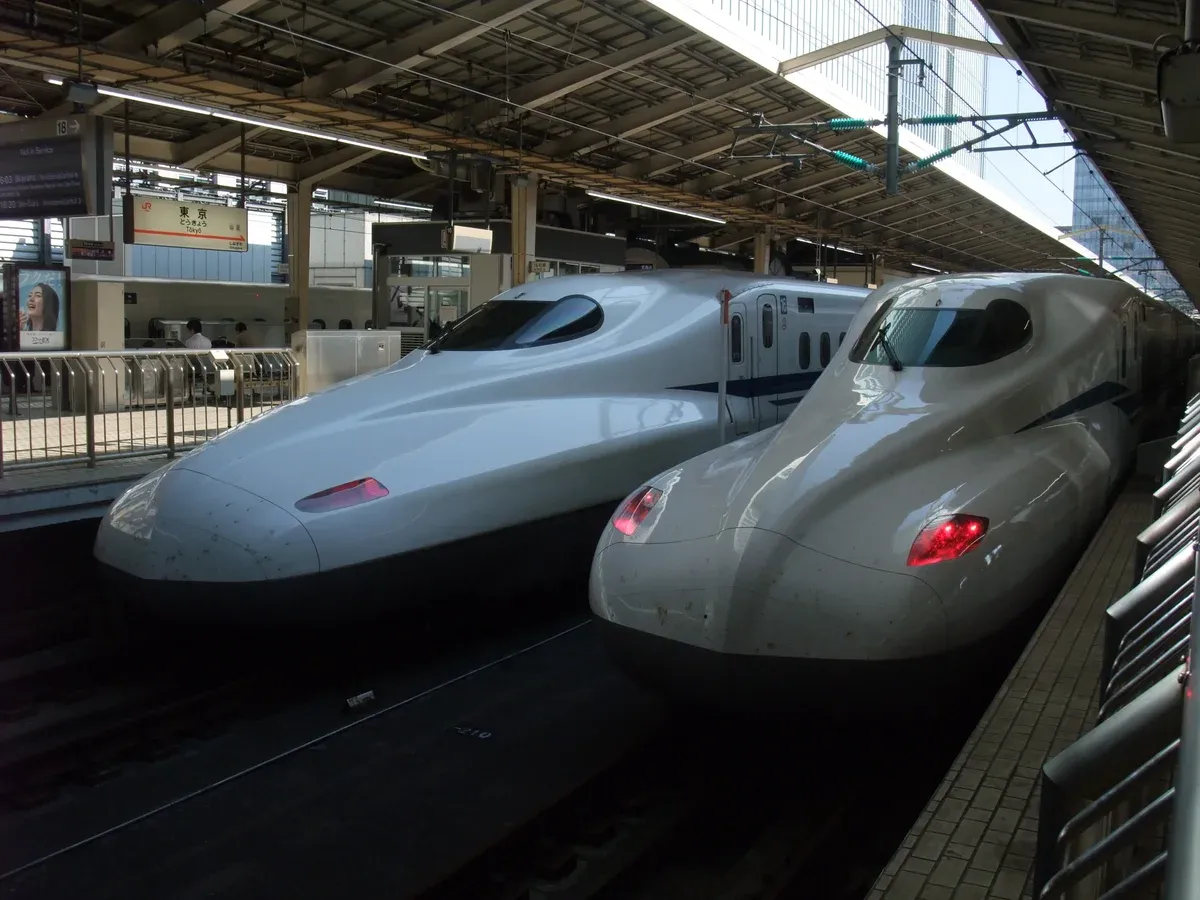
Two Tokaido Shinkansen trains wait at a Tokyo Station platform. Photo: 電車(新幹線)でゴー!, CC BY-SA 4.0, via Wikimedia Commons
Quick answer The fast answer
The fastest way from Tokyo to Kyoto by bullet train is the Nozomi on the Tokaido Shinkansen from Tokyo Station, which takes about 2 hours 15 to 2 hours 20 minutes and costs 14,170 yen for a reserved regular seat or 13,320 yen unreserved. Nozomi trains run about four an hour in each direction on a standard timetable, and more at peak. Trains stop at Shinagawa and Shin-Yokohama before Kyoto. For the Mt Fuji view, book seat E in a standard car.
Key takeaways
- Fastest option: the Nozomi from Tokyo Station in about 2 hours 15 to 2 hours 20 minutes, reserved seat 14,170 yen, unreserved 13,320 yen. Compare every fare in the price table.
- Full step-by-step route, from buying the ticket to walking out of Kyoto Station, in the step-by-step guide.
- Holding a Japan Rail Pass? You still cannot just board the Nozomi. See the JR Pass rule.
- Short on time or travelling with kids? The Kyoto 1-day guided tour covers the round-trip bullet train, lunch and a licensed guide.
Which Way to Kyoto by Bullet Train Suits You
If You are watching every yen
Ride a Kodama or Hikari with a non-reserved seat for the same 13,320 yen as the Nozomi non-reserved fare, and accept a ride of about 3 hours 40 minutes or 2 hours 40 minutes instead of about 2 hours 20. The fares sit in the Nozomi, Hikari or Kodama table.
If You hate planning and want one booking
Take the Kyoto 1-Day English-Guided Tour at $443.95. The round-trip bullet train fare, lunch and the afternoon sightseeing are included.
If You are a family with children and luggage
Reserve seats so everyone sits together, read the oversize baggage rules, and note that bags of 160 to 250 cm total need a free oversized baggage seat reservation.
If You are short on time and want the fastest door-to-gate run
Book a reserved Nozomi seat through Smart EX for 13,970 yen. The Nozomi stops only at Shinagawa, Shin-Yokohama and Nagoya on the way. Follow the step-by-step route.
If You want a guide explaining temples in English
The DIY train gets you to Kyoto Station, but no guide. The Kyoto 1-Day English-Guided Tour includes a licensed guide, lunch and the return train, and the arrival section shows what you would cover alone instead.
All the Ways from Tokyo to Kyoto by Bullet Train
Every practical way to cover the 515.4 km between Tokyo Station and Kyoto Station, with the exact fares and journey times from the published sources below.
The Comparison at a Glance
The table below lines up the three Tokaido Shinkansen services, the JR Pass route and the one guided day tour that covers the route. Fares are one way per adult unless marked. Times are for the fastest services of each type.
Where two sources give slightly different figures, both are printed so you can judge for yourself.
| Way | From | Time | Cost | Best for |
|---|---|---|---|---|
| Nozomi | Tokyo, Shinagawa or Shin-Yokohama Station | about 2 h 15 to 2 h 20 | 14,170 yen reserved, 13,320 yen non-reserved, 19,040 yen Green Car | Speed and frequency |
| Hikari | Tokaido Shinkansen stations | about 160 min | 13,850 yen reserved, 13,320 yen non-reserved | JR Pass holders who accept a slower run |
| Kodama | Tokaido Shinkansen stations | about 4 h (about 3 h 40 fastest) | 13,850 yen reserved, 13,320 yen non-reserved | Travelers who value a non-reserved seat over speed |
| 7-day ordinary Japan Rail Pass plus the Nozomi Mizuho Ticket | Tokaido Shinkansen stations | about 2 h 15 to 2 h 20 on the Nozomi | 50,000 yen pass online (53,000 yen via overseas agency) plus the 4,960 yen Nozomi ticket | Longer itineraries across Japan |
| Kyoto 1-Day English-Guided Tour | Tokyo City i at Tokyo Station | 12 hours | $443.95 | Travelers who want trains, guide and lunch in one booking |
Why the Train Wins This Corridor
The Tokaido Shinkansen opened on 1 October 1964 as the world's first high-speed rail line and its top operating speed is 285 km/h. In peak operation the line carries up to 17 trains an hour, made up of 13 Nozomi, 2 Hikari and 2 Kodama, which means you rarely wait long at the gate. The choice that matters on this corridor is which Shinkansen service and which seat type.
For a one-way ride the plain math favors a non-reserved Hikari or Kodama seat at 13,320 yen, and for a full day with zero decisions the Kyoto 1-Day English-Guided Tour at $443.95 bundles the trains, a guide and lunch. If you are building a wider Japan itinerary around trains, the planning advice in how to plan a day trip from Tokyo sits alongside this page.
Sources: JR Shinkansen, Tokyo Cheapo, japan-guide, Wikipedia
Kyoto by Bullet Train on Your Own, Step by Step
The full DIY run, from ticket purchase in Tokyo to the exit gates at Kyoto Station, with every fare and figure from the published sources.
Step 1. Buy Your Ticket
You have three routes to a ticket. At the station, ticket machines and JR counters sell reserved and non-reserved Tokaido Shinkansen tickets. On your phone, the Smart EX app has no annual fee, needs a credit card, and covers reserved and non-reserved seats on the Tokaido, Sanyo and Kyushu Shinkansen including the Nozomi.
It accepts overseas Visa, Mastercard, Amex, JCB and Diners cards, but the card must be enrolled in 3D Secure 2.0 with your bank, it bills in yen, and since 27 September the cardholder name must be registered in Roman letters. Booking the Nozomi reserved seat through Smart EX costs 13,970 yen, 200 yen below the 14,170 yen counter price. If you book at least 21 days ahead, the EX Hayatoku 21 product sells reserved ordinary-car Nozomi seats at a lower fare.
- Counter or machine: Nozomi reserved 14,170 yen, non-reserved 13,320 yen
- Smart EX app: Nozomi reserved 13,970 yen, saved 200 yen against the counter price
- Book 21 or more days ahead for EX Hayatoku 21 discounted Nozomi seats
Step 2. Get to the Right Station
Tokyo, Shinagawa and Shin-Yokohama are the three Tokaido Shinkansen stations before the line continues to Nagoya, Kyoto and Shin-Osaka. Any of them works. Inside Tokyo Station, just past the ticket gates on the first floor, Ekibenya Matsuri in Gransta sells more than 170 types of ekiben, one of Japan's largest ekiben shops, if you want a boxed meal for the ride.
Step 3. Pick Your Train and Seat
The Nozomi takes about 2 hours 15 to 2 hours 20 minutes and between Tokyo and Kyoto stops only at Shinagawa, Shin-Yokohama and Nagoya. The Hikari takes about 160 minutes and the Kodama about 4 hours, because both stop at more stations. Since the 15 March timetable change a Nozomi carries only two non-reserved cars, cars 1 and 2, outside peak periods, down from three.
During Golden Week, Obon and the New Year period the Nozomi runs with all seats reserved, so there is no non-reserved option at all. For the Mt Fuji view, sit on the right side of the train from Tokyo: seat E in a standard car or seat D in the Green Car, with the mountain appearing around Shin-Fuji about 40 to 45 minutes in.
- Nozomi: about 2 h 15 to 2 h 20, stops only at Shinagawa, Shin-Yokohama and Nagoya
- Non-reserved on the Nozomi means cars 1 and 2 only, outside peak periods
- All-reserved Nozomi during Golden Week, Obon and New Year
- Mt Fuji seat: E in a standard car, D in the Green Car
Step 4. Know the Baggage Rules Before You Queue
Trains accept up to two pieces of luggage with a combined size of 250 cm and no side over 200 cm. On the Tokaido, Sanyo and Kyushu Shinkansen, bags totalling 160 to 250 cm need a free oversized baggage seat reservation, and travelling with such a bag and no reservation costs a 1,000 yen fee. If your suitcase crosses 160 cm, book the oversized baggage seat at the same time as your ticket, since the reservation is free.
Step 5. Check These Things Before You Leave
Confirm your train is a Nozomi if you hold a Japan Rail Pass, because you need the separate Nozomi Mizuho Ticket described below. Confirm whether your travel date falls in Golden Week, Obon or the New Year period, when non-reserved travel disappears. Check your bag size against the 160 cm threshold.
And if you plan to work on the way, free Shinkansen Wi-Fi on the Tokaido line on N700S and N700A trains is limited to 30-minute sessions that can be repeated, so download anything you need before boarding.
Sources: Smart EX, JR Pass luggage guide, japan-guide, Shinkansen seat guide
Tokyo to Kyoto by Shinkansen: DON'T MAKE THIS MISTAKE!
Buying the ticket, the platform and the seat on the Tokaido Shinkansen. Third-party video by Jay and Karolina. This site did not shoot it and has no relationship with the creator.
Nozomi, Hikari or Kodama
The three Tokaido Shinkansen services share the same track and the same stations in Tokyo, and differ only in speed, stopping pattern and what a rail pass gets you.
The Three Trains Compared
The table gathers the published times and fares for the Tokyo to Kyoto run. Reserved Hikari and Kodama seats are 320 yen cheaper than the Nozomi, while non-reserved seats cost the same 13,320 yen on all three services. Nozomi trains run about four an hour in each direction on a standard timetable, with more at peak, against two Hikari and two Kodama an hour.
| Train | Time to Kyoto | Fare | JR Pass |
|---|---|---|---|
| Nozomi | about 2 h 15 to 2 h 20 | 14,170 yen reserved, 13,320 yen non-reserved, 19,040 yen Green Car, 13,970 yen via Smart EX | Not covered. Needs the separate Nozomi Mizuho Ticket at 4,960 yen extra |
| Hikari | about 160 min | 13,850 yen reserved, 13,320 yen non-reserved | Covered by the ordinary Japan Rail Pass |
| Kodama | about 4 h (about 3 h 40 fastest) | 13,850 yen reserved, 13,320 yen non-reserved | Covered by the ordinary Japan Rail Pass |
The JR Pass Rule That Catches People Out
On the Tokaido Nozomi and Mizuho a Japan Rail Pass holder needs a special ticket issued only to Japan Rail Pass holders, the Nozomi Mizuho Ticket, and JR Pass holders must buy it to ride the Nozomi. The Tokyo-Kyoto supplement is 4,960 yen. The 7-day ordinary Japan Rail Pass costs 50,000 yen bought online, or 53,000 yen through an overseas agency, and the 7-day Green pass costs 70,000 yen for adults with children aged 6 to 11 paying half.
So a 7-day pass holder riding one Nozomi to Kyoto pays the pass price plus 4,960 yen, which only pays off if the pass covers several more journeys. If your only long ride is this one, a plain ticket is almost always cheaper, a point the general passes overview in how to plan a day trip from Tokyo also makes for shorter routes.
When Non-reserved Is a Gamble
Some Kodama trains in the morning and evening rush hours are fully non-reserved apart from the Green Car, which is the opposite pattern to the Nozomi. On the Nozomi, non-reserved means cars 1 and 2 only outside peak periods since the 15 March timetable change, and the trains go all-reserved during Golden Week, Obon and the New Year period. If you arrive at the gate with a non-reserved plan on one of those dates, there is no cheaper way on board, you buy a reserved seat or wait for a Hikari or Kodama that still has open cars.
Sources: JR Shinkansen, Tokyo Cheapo, japan-guide, JR Pass price list
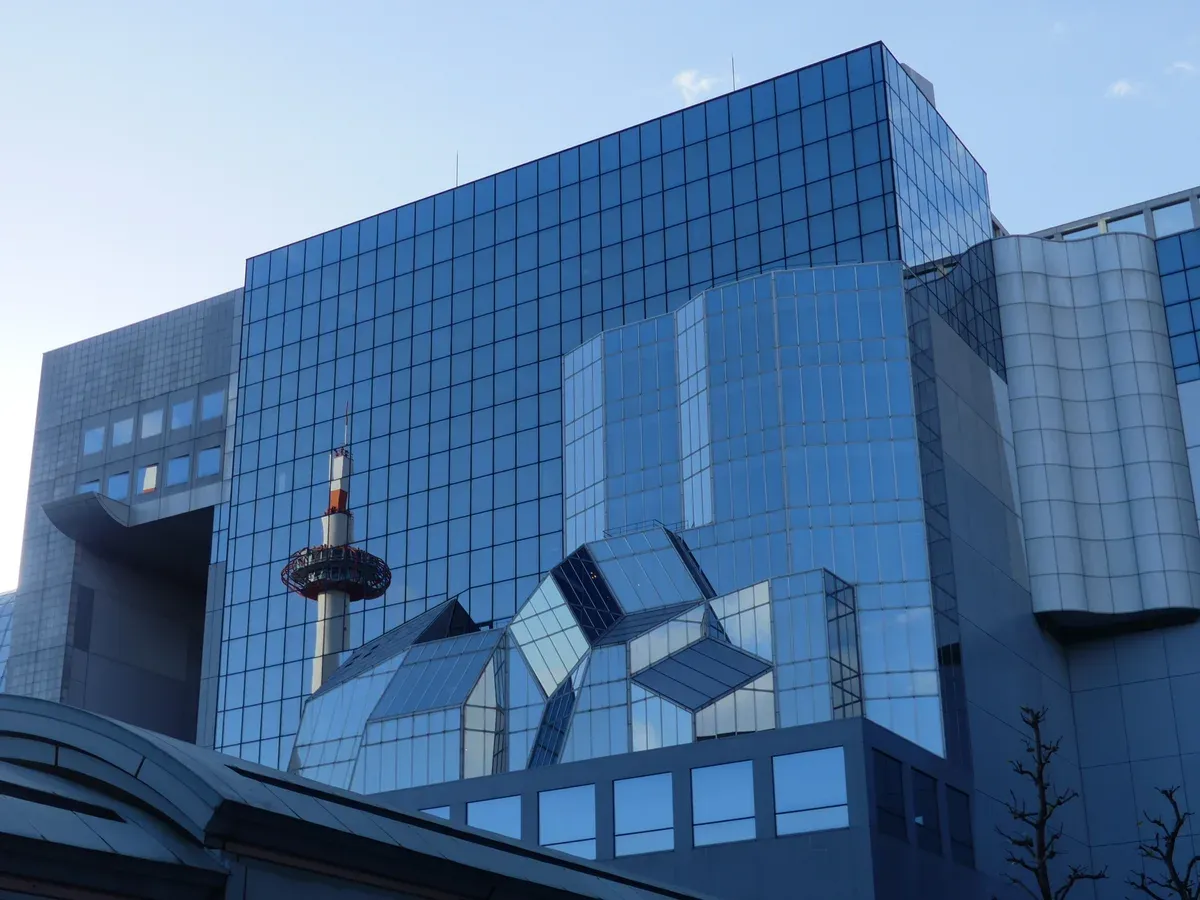
The glass facade of Kyoto Station reflects Kyoto Tower. Photo: Hubert Fourny, CC BY-SA 4.0, via Wikimedia Commons
Tickets and Hours at the Other End
You step off at Kyoto Station into a working transport hub with direct connections to the city's biggest sights. Here is what the main places charge and when they open, so you can plan the hours after arrival.
Getting from Kyoto Station to the Sights
Fushimi Inari is the fastest win from the station: it is just outside JR Inari Station, 5 minutes and 150 yen from Kyoto Station on the JR Nara Line, it is always open, has no closing days and charges no admission, and the full summit hike and back takes about 2 to 3 hours with many visitors turning back at the Yotsutsuji intersection after a 30 to 45 minute climb. Kiyomizu-dera sits 15 minutes away by bus 206 for 230 yen to the Gojo-zaka or Kiyomizu-michi stop, then a ten minute uphill walk. Arashiyama is 15 minutes and 240 yen on the JR Sagano Line to Saga-Arashiyama, and its bamboo groves and Togetsukyo Bridge are free to enter.
| Place | Entry fee | Hours | From Kyoto Station |
|---|---|---|---|
| Fushimi Inari | Free | Always open, no closing days | JR Nara Line, 5 min, 150 yen |
| Kiyomizu-dera | 500 yen | 6:00 to 18:00, until 18:30 in July and August, no closing days | Bus 206, about 15 min, 230 yen, plus 10 min uphill walk |
| Kinkaku-ji | 500 yen | 9:00 to 17:00, no closing days | Bus 205, about 40 min, 230 yen |
| Nijo Castle | 800 yen, 1,300 yen with Ninomaru Palace | Opens 8:45, entry until 16:00 | Not stated |
| Arashiyama bamboo groves | Free | Not stated | JR Sagano Line, 15 min, 240 yen |
| Tenryuji | 500 yen garden plus 300 yen buildings | 8:30 to 17:00 | JR Sagano Line to Saga-Arashiyama, 15 min |
Closure Days That Can Break an Afternoon
Most of Kyoto's headline sights never close, but the palaces inside Nijo Castle do. The Ninomaru Palace is closed every Tuesday in January, July, August and December and from 26 December to 3 January. The Honmaru Palace, which costs 1,000 yen on its own or 2,300 yen together with the Ninomaru Palace, is closed on the third Monday of each month and the day after.
Plan around those days if the palaces are the reason you are going. In the evening, Gion Corner shows run at 18:00 and 19:00 and tickets cost 5,500 yen, a workable finish to a day that started with a morning Nozomi from Tokyo.
Sources: japan-guide Kyoto pages, Nijo Castle
The Zero-Hassle Option: A Tour from Tokyo
One catalog tour in the comparison covers this corridor end to end, and it bundles everything the DIY route makes you arrange yourself.
What the Kyoto Day Tour Includes and What It Does Not
The Kyoto 1-Day English-Guided Tour from Tokyo by Bullet Train costs $443.95, runs 12 hours and takes up to 40 travelers by bullet train and bus with JTB Global Marketing & Travel Inc. The price includes the round-trip bullet train fare between Tokyo and Kyoto, lunch, a vegetarian-friendly Western-style set menu, and the afternoon sightseeing tour with an English-licensed guide. The meeting point is Tokyo City i, on the first basement floor of the KITTE building at Tokyo Station Marunouchi South Exit, so there is no hotel pickup.
Temple entry fees are not stated in the listing and fees other than those listed are not included, so budget for temple admissions from the table above. The honest trade: at 4.1 from 387 reviews it is the lowest-rated tour on this site, and Japan residents cannot book, but it removes every decision on this page for one payment. Cancellation is free up to 24 hours ahead.
If you want the wider catalog picture, the comparison of the best day trips from Tokyo puts this alongside the Fuji and Hakone options, and the dedicated Kyoto day trip from Tokyo page goes deeper on the itinerary itself.
Tokyo to Kyoto Bullet Train: Questions
How much does a bullet train from Tokyo to Kyoto cost?
The Nozomi costs 14,170 yen for a reserved regular seat or 13,320 yen unreserved, and a Green Car seat costs 19,040 yen. Reserved Hikari and Kodama seats are 320 yen cheaper at 13,850 yen with the same 13,320 yen non-reserved fare, and Smart EX takes 200 yen off the Nozomi reserved price at 13,970 yen. All figures sit in the fare comparison.
What is the bullet train from Tokyo to Kyoto called?
The line is the Tokaido Shinkansen, 515.4 km long and the world's first high-speed rail line when it opened on 1 October 1964, and the fastest service on it is the Nozomi. Hikari and Kodama trains run the same track with more stops, as the train comparison shows.
Is Shinkansen the same as bullet train?
Yes. Shinkansen is the Japanese name and bullet train is the English nickname for the same high-speed trains, including the Tokaido Shinkansen you ride from Tokyo to Kyoto. The step-by-step guide shows exactly how to board one.
What is the best bullet train to take from Tokyo to Kyoto?
The Nozomi, because it takes about 2 hours 15 to 2 hours 20 minutes against about 160 minutes for the Hikari and about 4 hours for the Kodama, and it runs about four times an hour on a standard timetable with more at peak. If you hold a Japan Rail Pass, weigh the 4,960 yen Nozomi Mizuho Ticket against a free Hikari ride of about 160 minutes, as the JR Pass rule explains.
How do I book bullet train tickets from Tokyo to Kyoto?
Buy at a station machine or JR counter, or use the Smart EX app, which has no annual fee, needs a 3D Secure 2.0 credit card, covers the Nozomi and bills in yen. Booking 21 or more days ahead unlocks the discounted EX Hayatoku 21 fare. The full buying process is in the step-by-step guide.
Which side of the bullet train is Mt Fuji on from Tokyo to Kyoto?
The right side. Book seat E in a standard car or seat D in the Green Car, and look for the mountain around Shin-Fuji about 40 to 45 minutes into the ride. Seat picking is covered with the reserved and non-reserved seat rules.